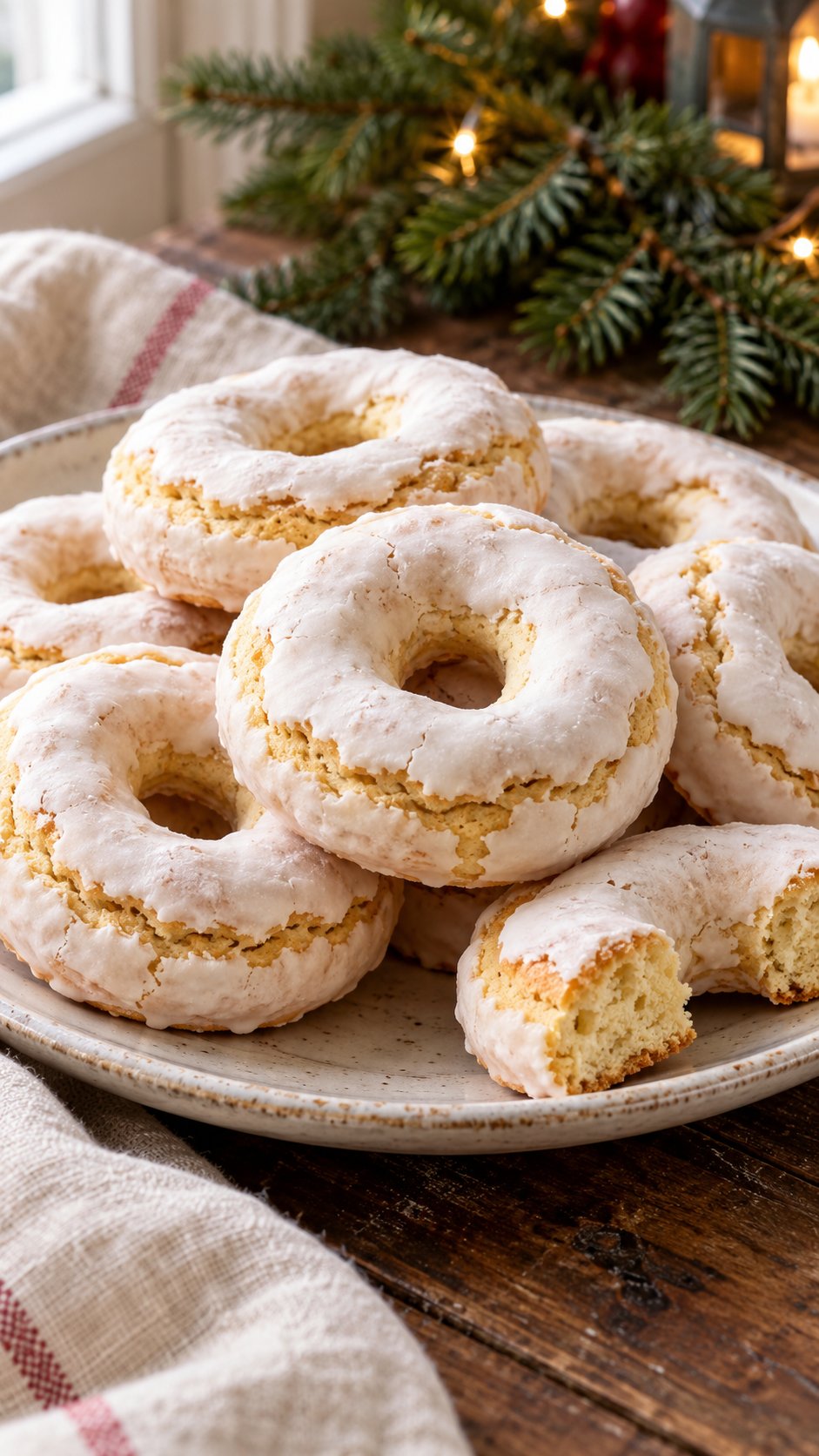
Calabrian-style egg-dough rings, boiled, scored around their outer edge and baked before receiving an opaque egg-free lemon sugar coat.
Calabrian Ginetti
Follow the tray sizes, portions and baking intervals in the instructions below.
Allow about 266 minutes: 50 hands-on, 50 chilling or resting, 76 whole-batch cooking and 90 cooling/setting. Cooling includes tray rest. Follow the method for batch sizes and doneness cues.
Kitchen tools you’ll need
- Kitchen scale or US measures
- Mixing bowl
- Kneading surface and bench scraper
- Large pot
- Slotted spoon
- Clean draining towel
- Small sharp knife
- Two parchment-lined 13 × 18-inch baking sheets
- Cooling rack
- Coating bowl and two forks
Calabrian-style egg-dough rings, boiled, scored around their outer edge and baked before receiving an opaque egg-free lemon sugar coat.
Ingredients
Optional sprinkles are for decoration and are not included in the nutrition estimate. Spice weights are approximate.
Instructions
Knead the egg dough
- 1Knead the egg doughWhisk eggs, granulated sugar, oil and salt. Add flour mixed with baking powder and knead for 5–7 minutes until smooth and firm but pliable. Cover and rest at room temperature for 30 minutes. This lightly sweetened egg dough is intentionally different from the soft drop-cookie dough of lemon anginetti.
Shape and boil the rings
- 2Shape and boil the ringsDivide dough into 16 portions, about 34 g each. Roll into 6-inch ropes about 1/2 inch thick and seal the ends securely into rings with a generous hole. Bring the measured boiling water to a gentle boil, allowing about 10 minutes. Cook two rings at a time, approximately 2 minutes per batch, until they rise and the outer surface firms. Allow 16 minutes for eight batches, plus the 10-minute water heating stage, all included under cooking.
Dry and score the circumference
- 3Dry and score the circumferenceLift with a slotted spoon onto a clean towel. After the last boiling batch, allow 20 minutes for draining and surface drying; total rest time is 50 minutes including the initial 30-minute dough rest. With a small sharp knife, cut a shallow horizontal groove around the outer circumference of each ring, about 1/8 inch deep. Do not cut through the ring or divide it into pieces.
Bake the scored rings
- 4Bake the scored ringsHeat the oven to 400°F (204°C) conventional or 375°F (191°C) fan. Arrange eight rings on each of two lined large sheets, 2 inches apart. Bake one sheet at a time for 22–25 minutes, allowing 50 minutes for both, until golden, dry and opened slightly along the scored outer seam. Total cooking is 76 minutes including heating and boiling. Rest on each sheet 10 minutes, then cool on a rack 20 minutes.
Add an egg-free lemon coat
- 5Add an egg-free lemon coatMix powdered sugar, lemon juice and the separate 15 g coating water into a thick smooth glaze. Turn each cold ring in the coating with two forks, drain excess and return to parchment. Keep the center hole open. Let dry uncovered about 60 minutes; cooling and coating-setting total 90 minutes after the last oven batch. This simple lemon glaze is an explicit home substitute for cooked naspro, not a claim to reproduce it.
Pack the dry rings
- 6Pack the dry ringsCheck that the coating is dry before stacking with parchment separators. All eggs are cooked in the boiled and baked rings; there is no raw-egg icing. The yield is 16 complete rings, not ring segments.
Chef’s Science & Pro Tips
Ingredient science
The outer circumferential cut helps the boiled skin open as the rings expand in the oven.
Technique & texture
Keep the join secure before boiling and use gentle water movement to avoid tearing it.
Finishing & serving
Use cooled rings for glazing; warm rings thin the coating and close the center hole with drips.
Storage and make-ahead
| Method | How long | What to do |
|---|---|---|
| Room temperature | Up to 3 days | Store fully cold rings with a dry coating airtight in a cool place. |
| Refrigerator | Up to 5 days | Use an airtight box in warm conditions; coating may soften. |
| Freezer | Up to 1 month, unglazed | Freeze completely baked cold rings, then glaze after thawing. |
| Make ahead | Bake on the preparation day | Complete boiling and baking in the same session; do not hold partly cooked rings overnight. |
| Finishing | After thawing | Thaw covered at room temperature, glaze and allow the full 60-minute setting period. |
Notes
- The outer circumferential cut helps the boiled skin open as the rings expand in the oven. Keep the join secure before boiling and use gentle water movement to avoid tearing it. Use cooled rings for glazing; warm rings thin the coating and close the center hole with drips. This home formula has not been kitchen-tested.
Nutrition
Approximate nutrition per serving calculated from ingredient weights divided by 16; required fillings and toppings included, optional decorations excluded. Brands, unused coating and actual serving size affect the estimate.
 THE COOKIE INDEXITALIANCHRISTMAS COOKIES
Frequently Asked Questions
Are ginetti the same as lemon anginetti knots?
No. This follows documented Calabrian boiled-and-baked rings with a scored edge, rather than soft knotted or scooped cookies.
Is this coating traditional cooked naspro?
No. It is a clearly labeled egg-free lemon sugar glaze for home use. Traditional naspro or gileppo requires a separate cooked-sugar method.
Are these exclusively Christmas cookies?
No. Primary Calabrian sources associate ginetti with Easter, local celebrations and family occasions; this collection does not redefine their season.
 Follow The Cookie Index on Pinterest
Share a little Italian Christmas joy
Send this recipe to someone who loves to bake.