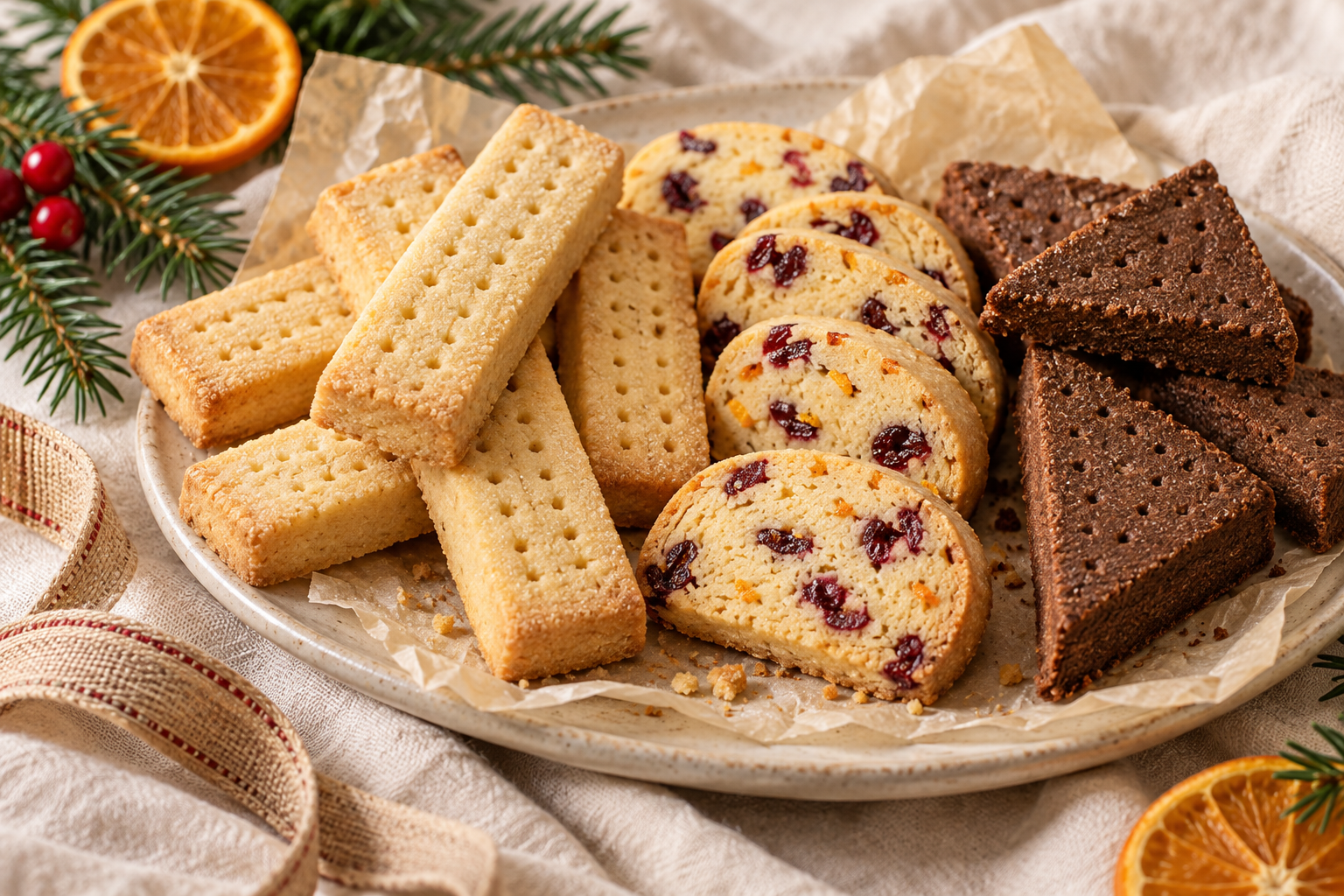
Use all flour toasted from the initial 240 g rather than measuring a new 240 g afterward.
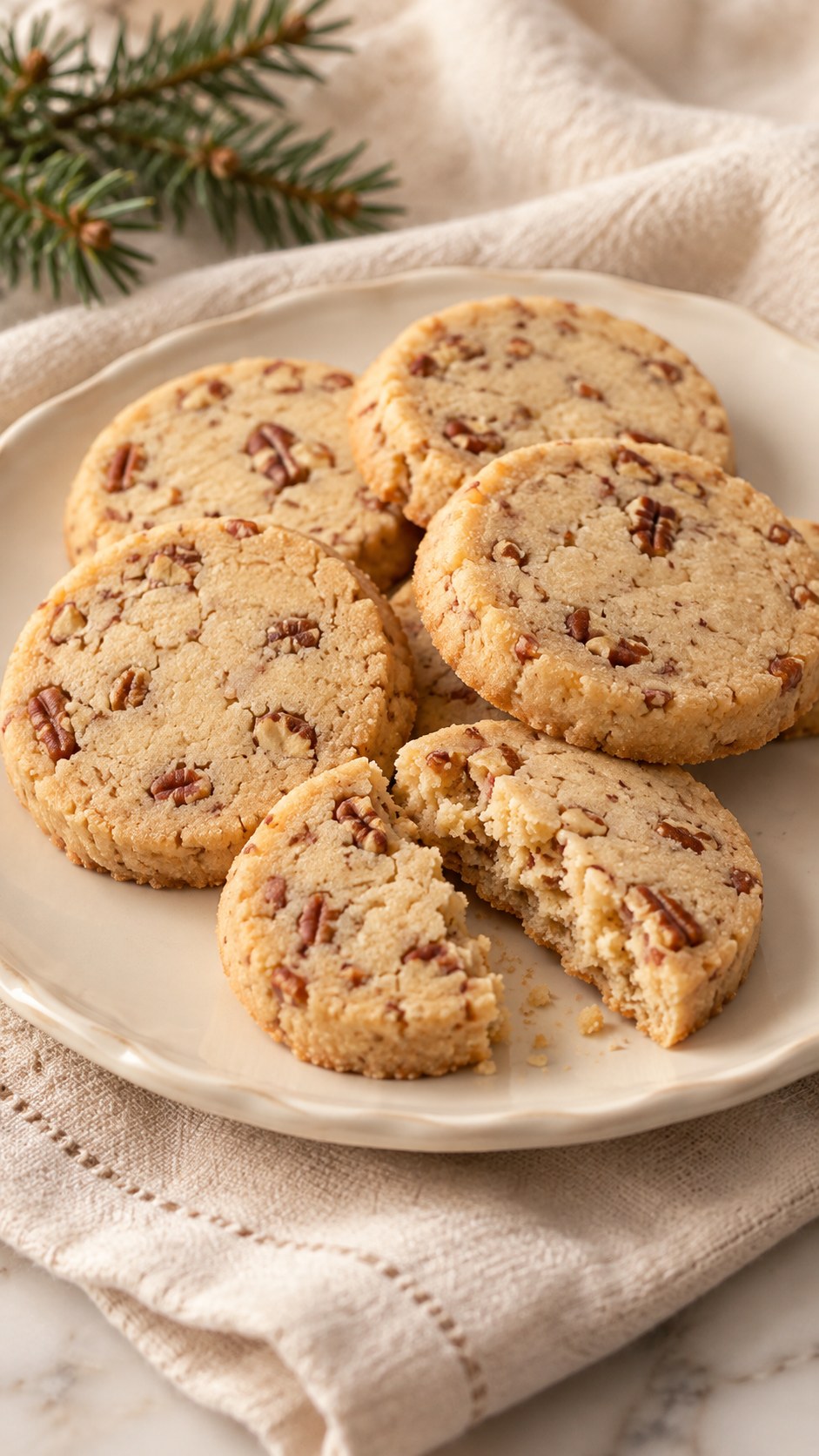
Pre-toasted flour and a whole egg make sandy, golden sablés with a deeper baked flavor.
As an Amazon Associate I earn from qualifying purchases.

Toasted-Flour Christmas Sablés Recipe
Follow the tray sizes, portions and baking intervals in the instructions below.
Total time includes hands-on preparation, required chilling or resting, whole-batch cooking, cooling and finishing.
Kitchen tools you’ll need
- mixing bowl
- mixer
- kitchen scale
- two 13 x 18-inch half sheets
- parchment
- sharp knife
- ruler
- plastic wrap
- wide spatula
- cooling rack
Ingredients
US measures are approximate. Gram weights help keep portions consistent; spice weights vary with density.
Instructions
Prepare special ingredients
- Prepare special ingredients: Spread flour on a parchment-lined half sheet. Toast at 350°F (175°C) conventional or 325°F (165°C) fan for 25–30 minutes, stirring every 5 minutes, until beige and nutty, not scorched. Cool 20 minutes and sift; use all the toasted flour.
Mix the dough
- Mix the dough: Beat butter and sugar until smooth, add egg, vanilla and salt, then cooled toasted flour. Mix just until cohesive.
Shape and manage temperature
- Shape and manage temperature: Form two 6-inch logs about 1 3/4 inches wide. Wrap and refrigerate 90 minutes. Slice each into 12 rounds, 1/2 inch thick, for 24 cookies.
Bake the whole batch
- Bake the whole batch: Heat oven to 325°F (165°C) conventional or 300°F (150°C) fan. Arrange cookies on two parchment-lined 13 x 18-inch half sheets, 12 cookies per tray, with at least 1 inch between edges. Bake one tray at a time on the middle rack, keeping the waiting tray refrigerated for 16–20 minutes, rotating front to back once, until the edges and bases are lightly golden and the centers look dry. Whole-batch cookie baking is 2 trays x up to 20 minutes = 40 minutes. With the up-to-30-minute flour-toast stage, bake totals 70 minutes.
Cool and finish
- Cool and finish: Rest 10 minutes on each tray, then cool 20 minutes on a rack before serving or packing. Cooling includes the tray rest.
Timing and scaling
- Timing and scaling: Active preparation is 35 minutes; required chill/rest is 90 minutes; whole-batch oven baking is 70 minutes; cooling/setting is 50 minutes. Cooling includes the extra 20-minute ingredient cooling stage before mixing. Cooling allowance runs from the final tray; earlier trays may cool during later baking and that overlap is not counted again. Start with butter at the stated consistency; ingredient warm-up and frozen-dough thawing are extra. Oven preheating can overlap shaping or chilling. Scale every ingredient weight but keep piece dimensions, oven temperature and per-tray bake range unchanged; extra trays increase whole-batch time.
Chef’s Science & Pro Tips
Ingredient science
Toasting changes flour's flavor and protein behavior; cool and sift before adding the egg.
Technique & texture
Use all flour toasted from the initial 240 g rather than measuring a new 240 g afterward.
Finishing & serving
Cut each 6-inch log into twelve even slices so the whole batch browns consistently.
Storage and make-ahead
| Method | How long | What to do |
|---|---|---|
| Room temperature | 5 days | Up to 5 days. Store completely cooled cookies airtight in a cool, dry room, with parchment between layers. Keep away from moist filled cookies. |
| Refrigeration | up to 7 days | Unnecessary; up to 7 days if needed. Baked refrigeration is unnecessary for these unfilled cookies and may soften the crumb. If the room is warm, seal airtight and bring to room temperature while still covered. |
| Raw freezing | 1 month | Up to 1 month. Freeze tightly wrapped logs airtight. Thaw overnight in the refrigerator until a knife can cut without cracking; slice cold and bake using the stated per-tray range. Allow additional thawing time beyond the fresh-batch timings. |
| Baked freezing | 2 months | Up to 2 months. Freeze fully cooled cookies airtight with parchment between layers. Thaw in their sealed container at room temperature for about 1–2 hours. |
| Restoring | As described | Serve after thawing; optional 3–5-minute refresh. For plain unfilled cookies only, refresh at 300°F (150°C) conventional or 275°F (135°C) fan for 3–5 minutes, then cool 20 minutes before sealing. This is extra time beyond the fresh recipe. |
Notes
- Scale ingredients, including US measures, without changing cookie size or oven temperature. Extra trays increase whole-batch time.
Nutrition
Approximate values per portion from the listed ingredient weights divided into 24 equal portions. Includes required fillings and finishes. Brands, unused coatings and actual portion size affect the estimate.
Frequently Asked Questions
Why is the bake field longer than two trays?
It includes 30 minutes for flour toasting plus 40 minutes for two cookie trays; brief oven stirring is included in the toast stage, not counted again as active preparation.
Does toasted flour eliminate the final baking step?
No; the egg-containing dough still requires a complete cookie bake.
Why include a whole egg in shortbread?
The 50 g egg adds cohesion to the toasted-flour dough and makes these sablés sturdier than egg-free shortbread.